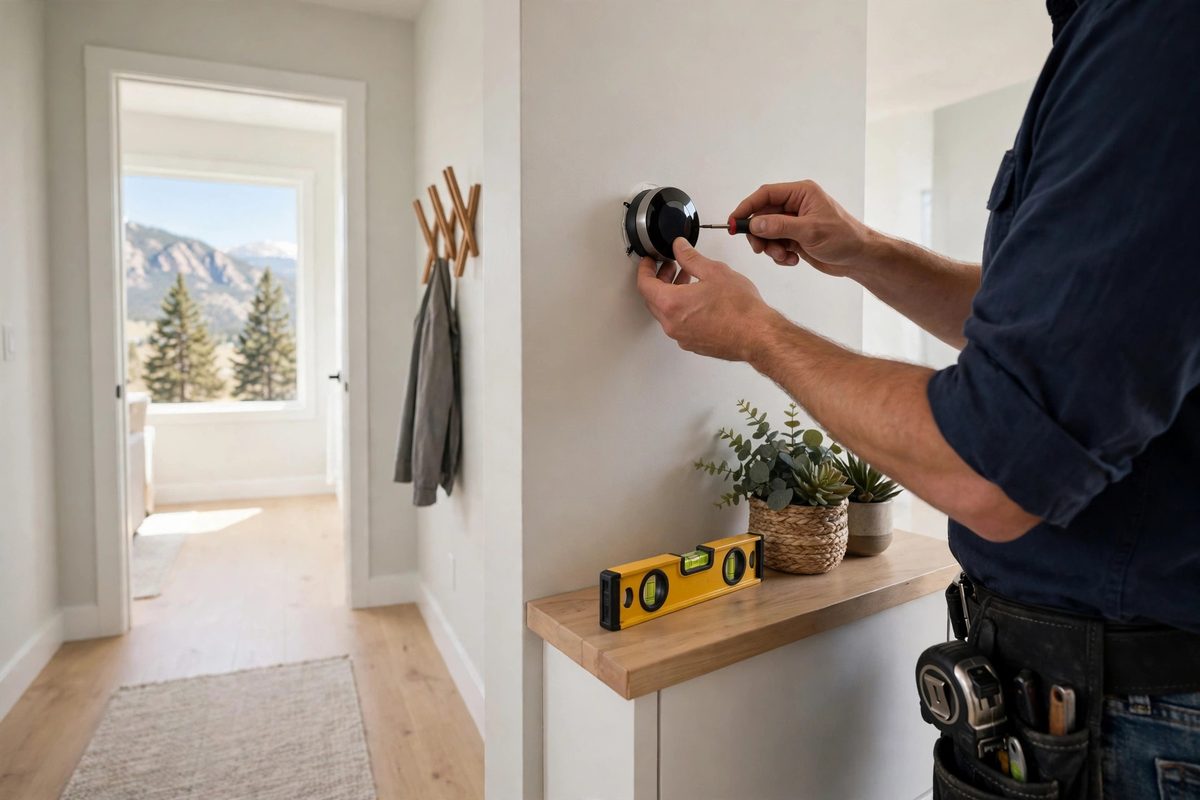
Ductless Mini-Split Installation in Fort Collins, CO
Some Fort Collins homes were never built for ducts. Old Town houses with strangled retrofit ductwork, additions, converted garages, and homes that still rely on evaporative coolers all share the same problem: no practical way to move conditioned air. A ductless mini-split is the standard answer — a cold-climate heat pump with no ductwork, one zone at a time. DNA Refrigeration installs mini-splits across Fort Collins. Call (970) 932-2324.
How a Ductless Mini-Split Installation Is Designed for a Fort Collins Home
A ductless mini-split is a heat pump split into two parts: an outdoor unit and one or more indoor heads, connected by a small line set. Each indoor head heats and cools its own zone, with its own thermostat. There is no ductwork to leak, no furnace to vent, and no central system to size — the design is zone by zone, which is exactly what a house without usable ducts needs.
The heating question is the same as for any heat pump in zone 5B: cold-climate capacity. A mini-split outdoor unit is selected for its rated capacity at 5°F, and in Fort Collins the honest design is usually a cold-climate model that holds its output through the heating season — 5,797 heating degree days, a design temperature around 0°F (ASHRAE 99.6% value 0.1°F), and about 150 freezing nights a year. A standard mini-split sized for a mild climate will not hold a Fort Collins room in January.
Placement is the part that needs local knowledge. The outdoor unit and the line set are exterior changes, and on buildings over 50 years old, exterior alterations need Historic Preservation review — which covers much of Old Town. Old Town’s design guidelines are voluntary and treat exterior HVAC as a visibility issue, not a ban: units are sited for the lowest visual impact, toward the rear, and hidden by a parapet where one exists. Homeowners’ associations commonly require architectural review for outdoor units too, and those rules are specific to each HOA. A mini-split installation triggers a mechanical permit in Fort Collins, applied for through the City’s Accela Citizen Portal.
Fort Collins sits at 5,003 feet, and the City’s mechanical guide puts furnace derating at 10–20% at this elevation — sea-level ratings do not apply here, so ductless mini-splits are sized from a Manual J load calculation at altitude, not from nameplate tonnage.
✓ Single-zone and multi-zone design
✓ Cold-climate outdoor units (70% capacity at 5°F)
Six decisions make a mini-split work in a house that was never built for ducts. Every installation we do covers all six.
01
✓
No Ductwork Needed
The whole point: conditioned air is delivered by the indoor head in each zone, not by ducts. For a historic home with strangled retrofit ducts, or an addition with no duct run at all, that is the difference between a working system and a renovation.
02
✓
Zone Control
Each indoor head is its own zone, with its own thermostat. A bedroom can be cool at night while the living room stays warm, and an unused room can be set back — zone control is built in, not bolted on.
03
✓
Cold-Climate Heating
The outdoor unit is selected for its 5°F capacity, not its nameplate. A cold-climate mini-split holds at least 70% of its capacity at 5°F, which is what a Fort Collins winter demands of any heat pump.
04
✓
First-Time Cooling
Many older Fort Collins homes were built for evaporative coolers or open windows, and about 14% of Coloradans have no air conditioning at all. A mini-split is first-time cooling that also heats — and unlike a swamp cooler, it works in humid August and does not admit wildfire smoke through open windows.
05
✓
Quiet Outdoor Units
Mini-split outdoor units run quietly, and placement is planned around the neighbours as well as the house: setback and noise are handled under the City’s Municipal Code, and the unit is sited where it is least visible and least heard.
06
✓
Rebates
Non-ducted heat pumps qualify for Efficiency Works rebates of $500 per ton as of November 2026, and the $1,000 Colorado state heat-pump tax credit applies to mini-splits as well, passed on as at least a $333 upfront discount. The federal 25C/25D credits ended 31 December 2025 and cannot be promised for a 2026 install.
How it works
What to Expect From Our Mini-Split Installation Process
We walk the house zone by zone: which rooms need heating and cooling, where the indoor heads can go, where the outdoor unit can sit, and what the existing heating is. The ductwork — or the lack of it — is part of the assessment.
Each zone is sized on its own load, the indoor heads are selected, and the outdoor unit is sized for the coldest nights. You get the options and the full scope in writing before anything is ordered.
The outdoor unit placement is planned for the lowest visual impact, and any HOA architectural review or Historic Preservation review for a building over 50 years old is handled before the install. The mechanical permit is applied for through the City’s Accela portal.
The outdoor unit is set, the line sets are run and insulated, the indoor heads are mounted, and the condensate drains are routed. The work area is left clean.
The lines are vacuumed and charged, each zone is run through heating and cooling cycles, airflow is verified, and the system is tested before the final inspection.
STEP 01Home Assessment
We walk the house zone by zone: which rooms need heating and cooling, where the indoor heads can go, where the outdoor unit can sit, and what the existing heating is. The ductwork — or the lack of it — is part of the assessment.
Tools & methods
Tools and Methods We Use on Every Mini-Split Installation
01
✓
Torque Wrench Set
Flare connections tightened to specification — a loose flare is the most common source of a slow refrigerant leak.
02
✓
Vacuum Pump and Micron Gauge
Pulls the line sets down to a deep vacuum before charging. Moisture or air left in the lines destroys compressors.
03
✓
Manifold Gauges
Reads refrigerant pressures and verifies charge against the manufacturer’s charging chart.
04
✓
Level and Plumb Tools
Indoor heads must be level for the condensate drain to work, and the drain must be pitched to flow.
05
✓
Electronic Leak Detector
Checks every flare and connection for leaks before the system is handed over. Refrigerant handling follows EPA Section 608 rules.
06
✓
Airflow Measurement
Confirms each indoor head moves the air volume it was designed for.
Real results
Mini-Split Installations We See Across Fort Collins
Ductless Mini-Split Installation
Old Town Home With No Ducts
Old Town homes are the classic mini-split case: historic floor plans with ductwork that was retrofitted badly or never existed, and buildings over 50 years old where exterior changes need Historic Preservation review.
After: The design puts indoor heads where they heat and cool the rooms that matter, sites the outdoor unit for the lowest visual impact — toward the rear, hidden by a parapet where one exists — and handles the review before the install starts.
A converted garage in Rigden Farm has no duct run and no practical way to extend one. A single-zone mini-split heats and cools the new room on its own, with its own thermostat, without touching the main system.
After: The install sizes the zone on its own load — a garage conversion has different insulation and exposure from the main house — and routes the condensate so it drains and does not freeze.
An addition in Southridge that the central system never reached is the other classic case: the main system was sized for the original house, and the new rooms are hot in summer and cold in winter.
After: A mini-split zone covers the addition on its own, leaving the central system to do the job it was sized for. The two systems are independent, so neither fights the other.
A zone sized to a guess will short cycle or never hold temperature. Each zone is sized on its own load — a garage conversion and a bedroom are not the same room.
↗02
Line-set routing
Line sets run badly look bad and leak. Routing is planned before the install: the shortest clean run, properly insulated, with the condensate pitched to drain.
↗03
Condensate drainage
A mini-split makes water, and that water has to drain. The drain is pitched and routed so it flows — and so it does not freeze in an unheated space.
↗04
Outdoor unit placement
An outdoor unit in the wrong place is noisy, visible, and hard to service. Placement is planned for the lowest visual impact, good airflow, and access for maintenance.
↗
Proof you can check
How HVAC licensing works in Fort Collins
Colorado has no state HVAC licence — HVAC work in Fort Collins is licensed by the City of Fort Collins, not the state. Colorado licenses only electricians and plumbers at the state level. Fort Collins licenses HVAC contractors through the City — ask us for our licence details when you call. We pull a mechanical permit for replacements through the City’s Accela portal, and size equipment to ACCA Manual J. Refrigerant handling follows EPA Section 608 rules.
City of Fort Collins contractor licensing — HVAC is licensed locally, not by the State of Colorado
Mechanical permits for furnace, AC and heat-pump replacements, applied for through the Accela Citizen Portal
ACCA Manual J load calculations, sized for 5,003 feet of altitude
5.0 ★ (23 Google reviews) — every review on Google is five stars
Customer reviews
What Fort Collins Customers Say
★★★★★
“We had a great experience working with this company. From the beginning, they have been incredibly open and helpful. They took the time to explain everything clearly, answer our questions, and genuinely work with us rather than simply trying to sell us a service. We really appreciate the effort they put into helping us find the best option for our situation. Highly recommend!!”
HC
Hannah ClarkGoogle review · a month ago
✓ Verified
“
★★★★★
“Fantastic business! Dennis is amazing, fixes, replaces, installs and knows everything about his profession. He under cut another competitor by $5800 and never exaggerates work that doesn't need doing. Very trustworthy, and very much appreciated. I have another whole AC unit that will need replacing soon, and I know who I'm going to for the job. Thanks!”
JH
James HadleyGoogle review · 5 months ago
✓ Verified
Good questions
Mini-Split Installation Questions Fort Collins Homeowners Ask
Published ranges, checked November 2026: Angi published $2,000–$5,000 for a typical single-zone system and $4,350–$12,250 for a ductless system in October 2026. Those are national figures — a multi-zone system with several indoor heads costs more than a single-zone install, and the final figure depends on the number of zones, the line-set routing, and the electrical work.
Cold-climate mini-splits do. They are heat pumps, and a cold-climate model is rated to hold at least 70% of its capacity at 5°F, with a COP of 1.8–2.3 at that temperature. Fort Collins’ 99.6% winter design temperature is around 0°F (ASHRAE 99.6% value 0.1°F), so the outdoor unit is selected for its 5°F capacity — a standard mini-split sized for a mild climate will not hold a room in January.
Yes. Mini-split installations trigger a mechanical permit in Fort Collins. Applications and inspection scheduling run through the City’s Accela Citizen Portal, and permits are valid for 180 days.
Yes, with placement planned around the rules. Buildings over 50 years old need Historic Preservation review for exterior alterations, and Old Town’s design guidelines — which are voluntary — treat exterior HVAC as a visibility issue, not a ban. The outdoor unit is sited for the lowest visual impact, toward the rear, and hidden by a parapet where one exists. There is no blanket ban on condensers in Old Town.
A mini-split is the answer for the room, the addition, or the whole historic house that ducts cannot serve. Call (970) 932-2324 and we will walk the zones with you, size each one, and plan the placement — including any HOA or Historic Preservation review. We are open 24 hours, every day.
Call us at (970) 932-2324 any time, day or night. We are open 24 hours, 7 days a week. There is no email address for the business — the phone is the way to reach us.