Disconnected runs reconnected
The most common find: a run that has come apart at a joint or a take-off, dumping conditioned air into the attic or crawlspace. It is reconnected, mechanically fastened and sealed, not just pushed back together.
Most duct problems are not dirt and not leaks — they are damage. A run common duct problems in the attic, a flex duct crushed by a box stored on top of it, a section collapsed after thirty summers, a take-off that was never connected properly in the first place. The symptoms are unmistakable: a room with no airflow at all, a register that blows weakly while the rest of the house is fine, or a system that runs constantly because half its air never arrives. Duct repair fixes the physical damage so the system can do its job. DNA Refrigeration Heating & Cooling repairs ductwork across Fort Collins. Call (970) 932-2324 any time.
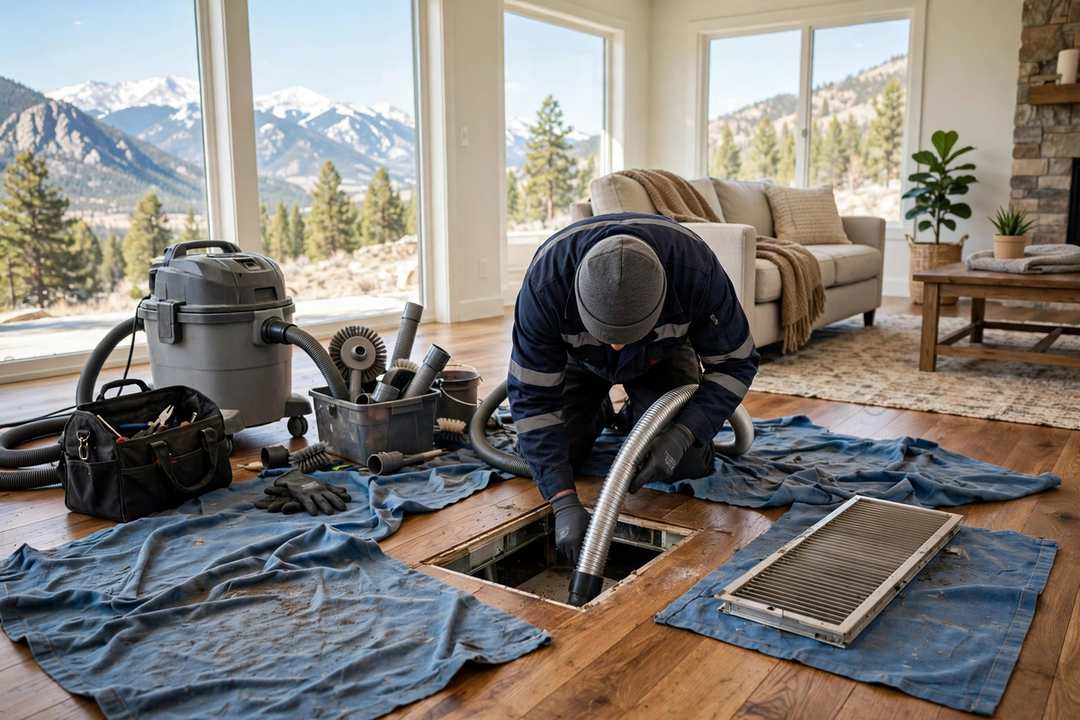
Duct repair is the physical fixing of damaged ductwork: reconnecting disconnected runs, replacing collapsed or crushed sections, repairing torn flex duct, refitting take-offs and registers, and supporting runs that have sagged until they kink. It is distinct from cleaning, which removes debris, and from sealing, which closes leaks — and an honest inspection says which of the three your ducts need.
The Fort Collins housing stock makes duct repair a common job. Nearly half the city's homes are pre-1990, and their ductwork has had thirty-plus years of attic heat, crawlspace damp and the occasional foot through a ceiling joist. Much of it was retrofitted into houses never built for ducts, which means runs threaded through tight spaces where they are easily crushed or kinked, and flex duct — common in later additions — that sags between supports until it chokes its own airflow. Manufactured and modular homes have their own pattern: crossover ducts under the house that disconnect or tear, which is a known failure in that stock. And the comfort symptoms that get blamed on the furnace or the air conditioner — the hot upstairs, the cold basement, the one room that never cools — are often a single damaged run. A repair visit starts with finding that run: airflow measured at every register, the accessible ductwork inspected, and a camera where the runs cannot be seen directly. No price figure is published on this page because no dated cost guide for duct repair was found in the November 2026 research.
A repair should restore airflow to the rooms that lost it, and leave the ductwork supported and sealed so it stays fixed. Here is what goes into that.
The most common find: a run that has come apart at a joint or a take-off, dumping conditioned air into the attic or crawlspace. It is reconnected, mechanically fastened and sealed, not just pushed back together.
Flex duct that has sagged, kinked or been crushed by storage is replaced with properly supported duct, with supports spaced so it cannot sag again. Rigid sections that have collapsed are replaced, not patched.
Tears in the inner liner or the outer jacket are repaired where the damage is small and the duct is otherwise sound, and replaced where it is not. A tear is a leak and a dust path at the same time.
Take-offs that were never properly connected and registers that blow weakly because the boot behind them is disconnected or crushed are refitted, so the air actually reaches the room.
Ducts that sag between supports kink and choke airflow. Runs are re-supported at proper spacing, so the repair lasts longer than the season.
After the physical repair, the system is tested for leakage so any remaining leaks are found and sealed, and the airflow at each register is measured to confirm the repair worked.
Call (970) 932-2324 any time. Tell us which rooms are affected, what the airflow feels like at each register, and whether anything changed recently — a renovation, attic work, a new roof.
We measure airflow at every register, inspect the accessible ductwork, and use a camera where runs cannot be seen directly, so the damaged run is found rather than guessed at.
You get a written quote naming the damaged sections and the repair method, with the distinction between repair, sealing and cleaning explained where it applies.
The damaged runs are reconnected, replaced or refitted, and re-supported at proper spacing. The work area is left clean.
We measure airflow at each register again and test for leakage, so the repair is proven by the numbers before we leave.
Call (970) 932-2324 any time. Tell us which rooms are affected, what the airflow feels like at each register, and whether anything changed recently — a renovation, attic work, a new roof.
Airflow at every register, before and after, so the repair is proven room by room.
Cameras that show the inside of runs that cannot be seen directly, finding collapses and disconnections without opening walls.
Leakage measured after the physical repair, so remaining leaks are found and sealed.
Replacement sections matched to the existing system, properly supported so they cannot sag again.
Durable sealing for the repaired joints, so a reconnected run stays connected.
Temperature differences across ductwork and registers that reveal disconnected runs and leaks.
Midtown's 1950s–1970s ranches often have ductwork that was added years after construction, threaded through attics where nobody has looked since. A run that has come apart at a joint dumps conditioned air into the attic, and the room it served gets nothing.
What good work addresses: finding the disconnected run by measuring airflow at every register, reconnecting and mechanically fastening it, sealing the joint, and verifying the airflow at the register afterwards.
Call (970) 932-2324 →Old Town's pre-1930 homes have additions and retrofitted runs threaded through tight spaces, where flex duct is easily crushed by storage or kinked where it turns. The room at the end of that run gets a whisper of air while the rest of the house is fine.
What good work addresses: replacing the crushed section with properly supported duct, re-routing it where the original path was the problem, and measuring the airflow at the register to confirm the fix.
Call (970) 932-2324 →Manufactured homes have their own duct pattern: crossover ducts under the house that connect the two halves, which disconnect or tear with age and movement. The symptom is one half of the home heating or cooling while the other does not.
What good work addresses: inspecting the crossover ductwork under the home, reconnecting or replacing the damaged section, and supporting it so it cannot disconnect again.
Call (970) 932-2324 →Duct repair is a diagnostic job first: find the damaged run, then fix it. These are the questions that start that conversation.
Ask a pro →Usually, yes. A room with no airflow while the rest of the house is fine almost always means a disconnected, crushed or collapsed run serving that room. Measuring airflow at every register finds it quickly.
No. Repair fixes physical damage — disconnected, crushed or torn ductwork. Sealing closes leaks in otherwise sound ducts. A house can need either or both, and the inspection is what decides.
If the cause is a damaged run starving the upper floor, yes. If the cause is undersized ducts or a system sized wrong at altitude, repair helps but does not fix it, and we will say so rather than sell a repair for a sizing problem.
The November 2026 research found no dated cost guide for duct repair, so this page publishes no price figure. Your written quote follows an inspection that names the damaged sections and the repair method.
“These guys rock! Anytime we need something, Denis pops in and fixes it like it was nothing. Everyone from their crew has a great attitude, and we won’t call anyone else for our heating, cooling, or other general maintenance work! Read the first sentence again.”
Mike DeeGoogle review · a year ago
“This guy was amazing. Came to the house and within minutes he diagnosed the problem and had my refrigeration unit up and running like brand new. Would recommend 10 out of 10”
Rob WheelerGoogle review · a year ago
A room with no airflow while the rest of the house is fine, a register that blows weakly, or a system that runs constantly are the signs. Measuring airflow at every register finds the damaged run quickly.
No. Repair fixes physical damage — disconnected, crushed or torn ductwork. Cleaning removes debris from inside the ducts. Sealing closes leaks in otherwise sound ducts. They are three different jobs, and the inspection decides which one your ducts need.
Yes. A disconnected run dumps conditioned air into the attic or crawlspace, so the system runs longer to hold the set temperature while one or more rooms get nothing. Reconnecting it is often the cheapest efficiency improvement a house can get.
No dated cost guide for duct repair was found in the November 2026 research, so no price figure is published here. Your written quote follows an inspection that names the damaged sections and the repair method.
Tell us which rooms are affected and we will measure the airflow at every register, find the damaged run, and quote the repair in writing. Open 24 hours, 7 days a week.
Call (970) 932-2324 →Call (970) 932-2324 any time, day or night. We are open 24 hours, 7 days a week, from 2757 Sternwheeler Dr, Fort Collins, CO 80524. Phone is the way to reach us — there is no email address for the business, so call any time, day or night — we are open 24 hours, 7 days a week.